
Braces and Supports for hEDS: How to Choose
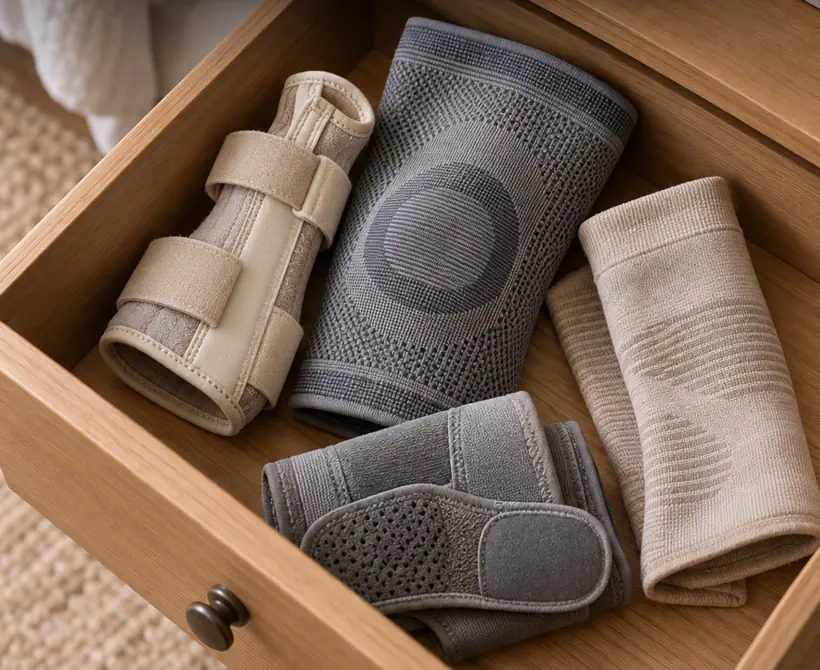
Most people with hEDS end up with a drawer of them. A wrist splint that never fitted properly. A knee sleeve bought in a panic after a bad subluxation. Something rigid that seemed sensible at the time and now lives at the back, unused.
Braces and supports genuinely help. But they help under specific conditions, and the drawer exists because nobody explains those conditions before you spend the money.
📋 The drawer exists because nobody was asked first
Almost every wasted purchase traces back to a conversation with a physio or doctor that never happened. Our free hEDS Appointment Kit is what makes that conversation worth having: which joints go and how often, what has already been tried, and what made things worse.
💯 100% free · 📄 3 printable pages, A4 and US Letter · 🚫 No spam, unsubscribe in one click
⚖️ The trade-off nobody mentions at the pharmacy
Here is the thing to understand before anything else.
A brace does the stabilising job that your muscles would otherwise be doing. That's exactly why it helps in the moment, and exactly why wearing one constantly can be counterproductive. Muscles that don't work weaken, and weaker muscles mean a joint that's less stable when the brace comes off.
This isn't an argument against braces. It's an argument for using them strategically: for specific activities, for flare periods, for recovery after a slip. Not as a permanent replacement for stability you could otherwise build.
The Ehlers-Danlos Society makes the same point about supports generally: it is important to keep doing appropriate exercise alongside them, so the muscles continue to be used and their strength maintained. Support, don't substitute.
🔗 Want more like this? Browse all our hEDS guides →
🧩 Rigid, soft, or compression: they do different jobs
Rigid or semi-rigid
Metal or plastic stays limiting movement in a specific direction. Useful after an acute injury or for a joint that dislocates repeatedly, generally under clinical guidance. The most restrictive, and the most likely to cause muscle deconditioning if worn continuously.
Soft neoprene or elastic
Mild support plus warmth, without much movement restriction. Popular for daily wear, and often the sensible starting point.
Compression sleeves
These work mostly through proprioception rather than mechanical support. The extra sensory input helps your brain track where the joint is in space, a genuine problem in hypermobility, which can reduce the number of slips even though the sleeve isn't physically holding anything.
Taping
Not a brace, but worth knowing about: adjustable, cheap, and a sensory input rather than structural support. A randomised trial in hEDS found short-term gains in shoulder rotation, though not, interestingly, in proprioception itself. Our guide to taping for hypermobility covers what the evidence does and doesn't show.
⚠️ One caution, and it's worth stating precisely. The concern with adhesives here is reaction, not fragility. Thin, easily torn skin is a feature of classical EDS rather than the hypermobile type. What does matter is that many hypermobile people also have mast cell activation, and adhesives are a recognised trigger. Patch test first, and remove slowly rather than fast.
📏 Six mistakes worth avoiding
Buying without measuring. Sizing charts assume typical joints. Measure, at the point the manufacturer specifies, at the time of day you'll wear it, since swelling changes things.
Going rigid first. Start with the least restrictive option that does the job. You can always escalate.
Wearing it all day by default. Decide what it's for, this activity or this flare, rather than putting it on every morning out of habit.
Ignoring what it shifts. Immobilise one joint and the load moves to the next one up or down. A wrist brace can produce elbow pain. Watch for it.
Treating it as a substitute for strengthening. A brace buys time and reduces risk. Building stability is still the long game, and it needs a physical therapist who understands hypermobility.
Not asking a PT first. A twenty-minute conversation about which joint, which type and when to wear it will save you more money than any discount code.
🎯 What good use looks like
The pattern that works for most people: identify the specific situations where a joint reliably gives you trouble, a particular task at work, long walks, a shift that involves lifting, and use support for those. Take it off the rest of the time. Keep strengthening in parallel.
Used that way, a brace isn't a sign of decline. It's a tool that lets you do more, which is exactly the same logic as pacing.
📋 Mistake six, solved on paper
"Ask a PT first" is the cheapest item on that list and the easiest to skip, usually because the appointment feels like it will go nowhere. The free hEDS Appointment Kit is what makes it go somewhere: three printable pages covering every system, the pattern behind them, and the three things to raise first.
Free, always. Unsubscribe in one click.
💚 Using support is not giving in
A lot of people delay for years because a brace feels like an admission. It isn't. A shower chair, a walking stick, a wrist splint: these are all the same thing, a way of spending your capacity on what matters instead of on staying upright. Our guide to choosing a mobility aid applies the same logic to getting around.
❓ Frequently asked questions
Can wearing a brace make hypermobility worse?
Constant use can allow the muscles that stabilise the joint to weaken, which may leave it less stable once the brace is removed. This is why the general guidance is to use support strategically, for specific activities, flares or recovery, rather than continuously, and to keep exercising alongside it.
Rigid or soft, which should I choose?
It depends on the joint and the situation. Rigid supports restrict movement and are usually reserved for acute injury or recurrent dislocation under clinical guidance; soft supports and compression sleeves offer milder support and proprioceptive feedback for everyday use. Starting with the least restrictive option that does the job is the usual approach.
Do compression sleeves actually do anything?
They provide relatively little mechanical support, but the sensory feedback can improve proprioception, your sense of where the joint is in space, which is often impaired in hypermobility. For some people that reduces the frequency of slips even without physical restriction.
Is kinesiology tape safe with hEDS?
Generally yes. The idea that hEDS skin is too fragile for tape confuses it with classical EDS, where thin and easily torn skin is a prominent feature. In the hypermobile type the skin is soft and stretchy rather than fragile. The real consideration is adhesive reaction, particularly for anyone who also has mast cell activation. Patch test first and remove tape slowly.
📚 Sources and further reading
The information in this article is drawn from the following sources. We encourage you to explore them.
The Ehlers-Danlos Society: Braces, Splints & Mobility Aids
The Ehlers-Danlos Society: Skin Features of EDS
Tudini F, Levine D, Healy M, et al.: Kinesiology taping techniques, shoulder range of motion and proprioception in hypermobile Ehlers-Danlos syndrome: a randomized controlled trial
Continue reading
⚕️ This article is general information for the chronic illness community and is not medical advice. Which support is appropriate for which joint should be decided with a physical therapist or doctor familiar with hypermobility.