hEDS Subluxations: What to Do When a Joint Slips Out
😰 The moment it happens
Your shoulder shifts sideways reaching for a mug. Your kneecap slides as you stand up from the sofa. Your jaw clicks out mid-yawn. For most people with hypermobile Ehlers-Danlos syndrome, the frightening part isn't the pain. It's the two or three seconds afterwards where you have no idea what you're supposed to do, and panic makes every muscle around the joint clamp down at exactly the wrong moment.
This is a calm walkthrough of what a subluxation actually is, what most people find helps in the moment, and, importantly, when it stops being something to handle at home.
📋 The slips you never report are the ones that count
Most people never mention a subluxation to a doctor, because the joint went back and it felt too minor, yet frequency and pattern are genuinely useful diagnostic information. Our free hEDS Appointment Kit gives them a place to be written down, next to everything else hypermobility brings along.
💯 100% free · 📄 3 printable pages, A4 and US Letter · 🚫 No spam, unsubscribe in one click
🦴 Subluxation vs dislocation: the difference matters
A dislocation is the displacement of a bone from its natural position in the joint. The two bones that form the joint separate completely, and it generally does not resolve by itself. A subluxation is a partial dislocation: the joint surfaces move out of alignment but stay partly in contact, and often slide back either on their own or with a small shift of position. A subluxation can be every bit as painful as a full dislocation.
Shoulders, knees, thumbs and ankles are among the most commonly affected joints, though it can happen almost anywhere.
In hEDS, the connective tissue that would normally hold joint surfaces firmly in place is more lax, so partial slips can happen with far less force than they would in someone else, sometimes during genuinely ordinary movements. That's not clumsiness and it isn't your fault. It's the same underlying tissue difference behind the other hEDS flare patterns you may already recognise.
🔗 Want more like this? Browse all our hEDS guides →
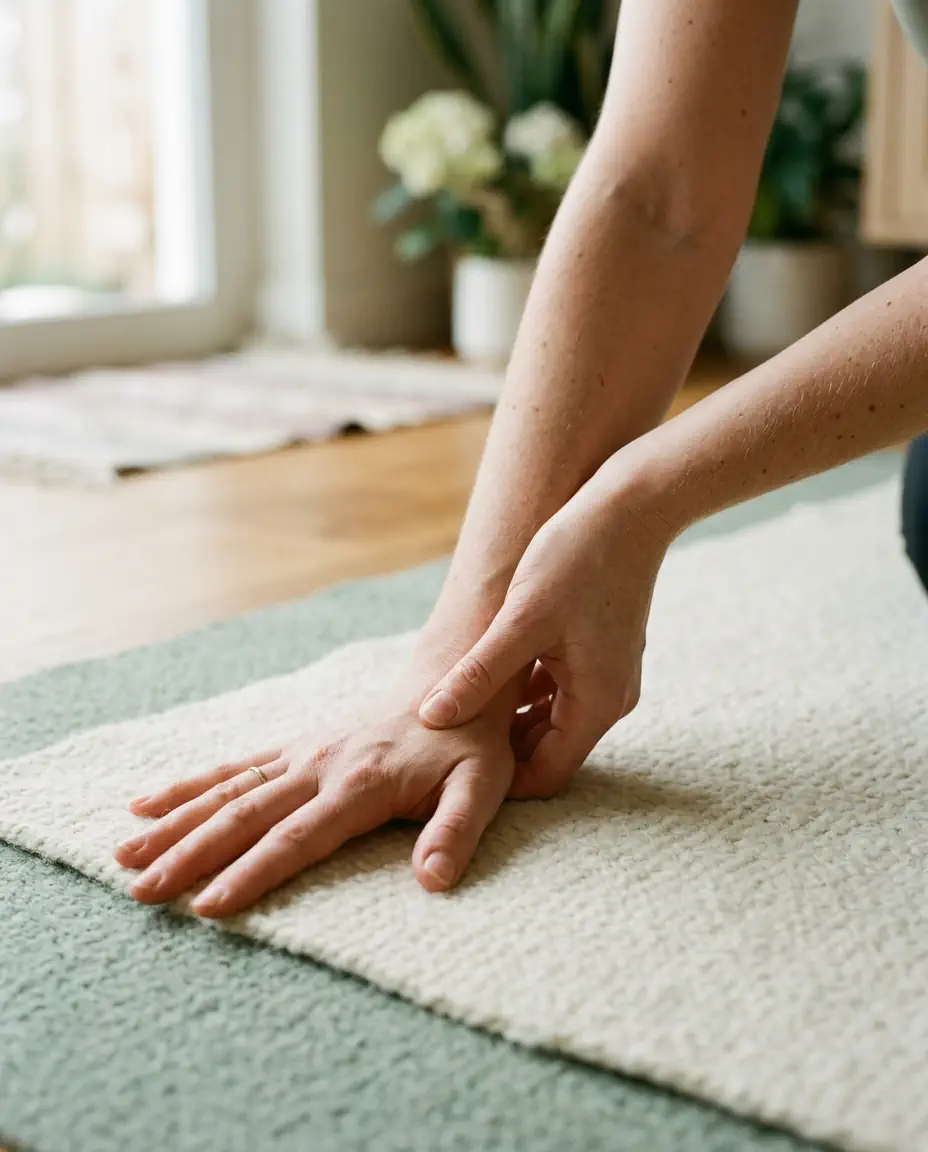
🧘 In the moment: what tends to help
Stop moving and breathe out slowly. This sounds like the least useful advice possible in the middle of it, but muscle guarding, meaning everything around the joint tensing protectively, is what makes a slip harder to resolve. A slow exhale does more than trying to force relaxation. Staying calm is the single point specialist physiotherapy guidance returns to most.
Support the limb rather than dangling it. Letting the weight of an arm or leg hang pulls on a joint that's already unstable. Resting it on a cushion, a table, or your other hand takes the load off.
Move gently back towards a neutral position. Many subluxations reduce themselves when the limb returns to a relaxed, supported position, without force, twisting, or anyone yanking on it.
Do not let someone "pop it back in" for you. Well-meaning family members doing this can cause real damage, particularly to soft tissue and nerves. If a joint doesn't return on its own, that's a medical situation, not a DIY one.
Afterwards, treat it as a real injury. The joint has been through something even if it looks fine. Gentle support, rest, and the joint protection basics apply for the rest of the day at minimum.
🚨 When to stop and get medical help
Home management stops being appropriate when any of these apply:
The joint hasn't gone back after gentle repositioning, or is visibly deformed.
There's numbness, pins and needles, or loss of colour below the joint, which can mean nerve or circulation involvement.
You can't move or bear weight on it at all.
Pain is severe, or clearly different from your usual subluxation pain.
It followed significant force: a fall, an impact, a car journey gone wrong.
None of those are overreactions. A fracture can accompany a dislocation, and hEDS doesn't protect you from that.
🛡️ Reducing how often it happens
You can't change your connective tissue, but frequency isn't fixed either. The three levers most consistently discussed for hEDS joint stability are strengthening the muscles that support unstable joints (ideally with a physical therapist who understands hEDS, since generic protocols can backfire), improving proprioception so your body senses joint position more accurately, and using braces or supports strategically rather than constantly, since over-reliance can let supporting muscles weaken further.
Fatigue matters too. Tired muscles support joints less well, which is part of why slips cluster at the end of a long day rather than the start.
💚 Your first one is genuinely frightening
Nobody warns you what a subluxation feels like before it happens, and the fear afterwards, of moving normally, of it happening in public, is a completely reasonable response to your body doing something alarming without permission. It gets less frightening as you learn your own pattern. That isn't the same as it not mattering.
📋 "It happens sometimes" is what gets shrugged at
Which joints, how often, and after what: that is the version a rheumatologist can act on, and it is nearly impossible to assemble from memory in the room. The free hEDS Appointment Kit is three printable pages for exactly that, including a page for what each symptom stops you doing.
Free, always. Unsubscribe in one click.
❓ Frequently asked questions
What is the difference between a subluxation and a dislocation?
A dislocation is a complete separation of the two bones forming a joint, and it usually will not resolve on its own. A subluxation is a partial dislocation, where the surfaces move out of alignment but stay partly in contact. A subluxation can be just as painful as a full dislocation.
Is it normal to sublux joints daily with hEDS?
Frequency varies enormously between people with hEDS. Some experience occasional slips, others far more often. Daily subluxations are worth discussing with a rheumatologist or hEDS-aware physical therapist, since a change in frequency can point to something addressable.
Should I use a brace after a subluxation?
Short-term support after a slip is common practice, but constant bracing can allow supporting muscles to weaken over time. A physical therapist familiar with hypermobility can advise on when and how much to use support for your specific joints.
Can subluxations cause long-term damage?
Repeated joint instability can contribute to soft tissue and joint wear over time, which is why prevention and appropriate strengthening are taken seriously in hEDS care rather than treated as cosmetic concerns. Discuss ongoing patterns with your specialist.
How do I keep track of slips without making it a chore?
One line is enough: which joint, roughly what you were doing, and whether it went back on its own. Written the same day, because the detail that gets lost first is what preceded it. A month of those single lines is what turns "it happens sometimes" into a pattern someone can work with.
📚 Sources & further reading
The information in this article is drawn from the following sources. We encourage you to explore them.
The Ehlers-Danlos Society: Dislocation and Subluxation Management
Ehlers-Danlos Support UK: Managing dislocations and subluxations in hypermobile Ehlers-Danlos syndrome and hypermobility spectrum disorders
University College London Hospitals NHS Foundation Trust: Managing dislocations and subluxations
Continue reading
⚕️ This article is general information for the chronic illness community and is not medical advice. Never attempt to force a joint back into place, and seek urgent medical assessment for a joint that will not reduce, numbness, or severe pain.