
Hypermobility Aids: Choosing a Cane, Rollator or Wheelchair
Most people do not reach for a mobility aid too early. They reach for one about two years too late, after a long stretch of cancelling things, sitting on walls, and calculating whether a shop is worth the walk from the car park.
The question worth asking is not "am I disabled enough for this?", it is "would this let me do something I currently say no to?" That is the framing the Ehlers-Danlos Society uses, and it is a far better test than how you feel about the word "aid".
📋 "What do I currently say no to?" Write it down
That question is also the one an assessment turns on, and it is the hardest to answer on the spot. Our free hEDS Appointment Kit has a page built around it: three symptoms, and beside each one what it stops you doing. Plus the whole systemic picture on a sheet you can hand over.
💯 100% free · 📄 3 printable pages, A4 and US Letter · 🚫 No spam, unsubscribe in one click
🚶 hEDS and POTS ask different things of an aid
This matters more than most buying guides admit, because the two conditions want opposite features.
With hypermobility, the job is offloading unstable joints, taking weight off ankles, knees, hips and lower back so they are not absorbing every step. Endurance, not strength, is usually what runs out first.
With POTS, the job is having somewhere to sit before you need it. Standing still is the problem, so an aid that only helps you walk misses the point entirely. This is the same mechanism behind why queues are worse than walking.
If you have both, a seat is non-negotiable, which rules out canes and crutches as your only aid.
🔗 Want more like this? Browse all our hEDS guides →
🦯 Canes, crutches, rollators: what each actually does
A single cane offloads one side and helps with balance. The catch for hypermobility is that all of that load now goes through one wrist, one elbow and one shoulder, joints that may be no more stable than the ones you are protecting. Ehlers-Danlos News flags this directly: shifting weight onto a cane or crutch can injure other joints if it is not done carefully.
Forearm crutches spread load through the cuff and forearm rather than concentrating it in the hand, which is why many hypermobile people find them easier than a cane despite looking like the bigger step. Used as a pair, they also keep you symmetrical.
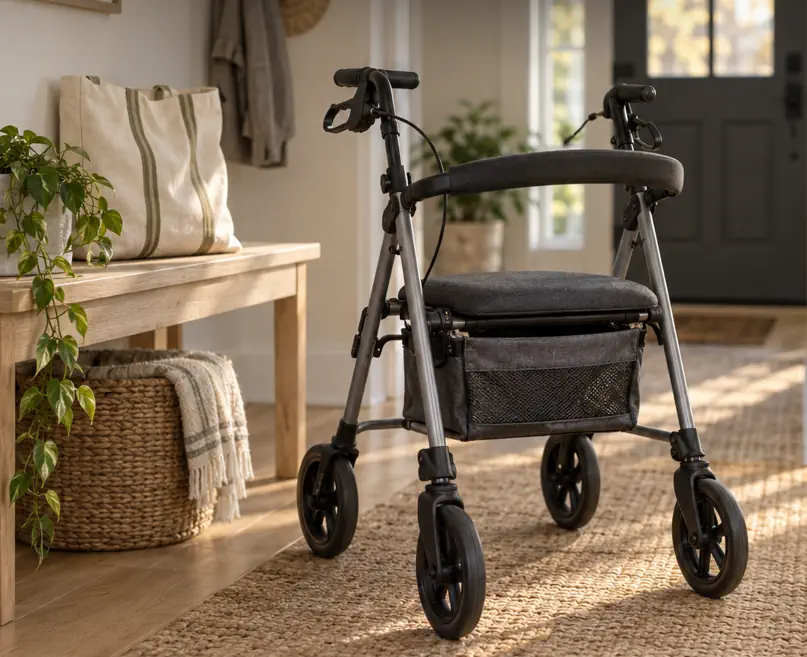
A rollator is the one most people underestimate. It offloads, it gives you brakes on a slope, and it carries a seat and your bag. For anyone with POTS, that seat is the whole feature: you sit before the presyncope, not after.
A wheelchair, manual or powered, is for the distances that were never realistically walkable. Used situationally, for the museum, the airport, the day out, it is not a step you cannot come back from.
⚖️ The caveat that deserves stating honestly
The Ehlers-Danlos Society is clear that wheelchairs are not standard practice in hEDS and HSD, and that only a small percentage of people need one. Their reasoning is worth understanding rather than dismissing: deconditioning happens quickly when we stop moving. Removing walking from daily life can weaken trunk and leg muscles, which can worsen joint instability, and can worsen POTS too, since the same muscles pump blood back up from your legs.
That is not an argument against mobility aids. It is an argument for using them alongside continued movement rather than instead of it, and for involving a physiotherapist experienced in prescribing them. Our guide to gentle movement covers the other half of that balance.
Their conclusion is the useful one: aids can be part-time, full-time or situational, and there is no single best option. What is right depends on what you are trying to make possible.
🛁 The aids nobody photographs
Mobility aids get all the attention, but the ones that change most days are duller and cheaper.
A shower chair is the highest-return purchase most people in this community make. Showering is genuinely demanding, with heat, standing and arms overhead all at once, and sitting through it removes most of the cost. Add a long-handled sponge and a handheld shower head and you have removed the overhead reaching too.
Beyond the bathroom: a perching stool for cooking, jar openers and lightweight pans for hands that sublux, a grabber to stop the bending-and-standing cycle, and a bag worn across the body rather than carried in a hand.
🧑⚕️ Get it fitted, not just bought
A badly fitted aid creates a new problem instead of solving one. A cane at the wrong height changes your gait and loads your shoulder. A rollator too high tips you forward. A poorly set-up wheelchair pushed by hypermobile shoulders is a shoulder injury waiting to happen.
A physiotherapist or occupational therapist can assess what you actually need, set it up, and teach you to use it. That assessment is usually free through the health system in both the UK and the US when it comes via referral. If you are looking for someone who understands hypermobility specifically, our guide on finding an hEDS-literate physical therapist covers what to ask.
📋 The assessment goes better with paper
An occupational therapist decides between a cane, crutches and a rollator based on what your days actually look like, not on how you describe them under pressure. The free hEDS Appointment Kit hands that over: what is worse and easier, what has already been tried and what made things worse, and the three things that matter most.
Free, always. Unsubscribe in one click.
Using an aid isn't losing ground. The people who wait longest are usually the ones who have absorbed the idea that needing help is a failure of effort. But nobody calls glasses giving up on seeing. An aid that gets you to your friend's birthday is not a smaller life, it is the larger one.
❓ Frequently asked questions
Am I disabled enough to use a mobility aid?
There is no threshold to cross. The Ehlers-Danlos Society frames it usefully: mobility aids are appropriate when they help someone turn a "no" into a "yes", enabling participation in activities you would otherwise skip. If an aid would let you do something you currently decline, that is the answer.
Will using a mobility aid make me weaker?
It can, if it replaces movement entirely. Deconditioning happens quickly when we stop moving, and losing trunk and leg strength can worsen both joint instability and POTS. The recommended approach is to use aids alongside appropriate exercise rather than instead of it, ideally with a physiotherapist involved.
Cane or forearm crutches for hypermobility?
Forearm crutches spread load through the cuff and forearm rather than concentrating it in one hand and shoulder, which many hypermobile people find easier despite the bigger appearance. A single cane also creates asymmetry. Either way, weight shifting onto an aid can injure other joints if the fit and technique are not right, so it is worth having assessed.
What's the best mobility aid for POTS specifically?
Usually something with a seat. Standing still is the core problem in POTS, so a rollator lets you sit before symptoms escalate rather than looking for somewhere to perch. A cane does not solve the standing problem at all.
Can I use a wheelchair only sometimes?
Yes. Wheelchairs can be used part-time, full-time or situationally depending on need, for long distances, big days out or flare periods, and using one occasionally does not commit you to anything.
📚 Sources & further reading
The information in this article is drawn from the following sources. We encourage you to explore them, and to have any mobility aid assessed and fitted by a qualified therapist.
The Ehlers-Danlos Society: Braces, Splints & Mobility Aids
Ehlers-Danlos News: Aids and Adaptations for EDS
Dysautonomia International: Lifestyle Adaptations for POTS
Continue reading
⚕️ This article is general information for the chronic illness community and is not medical advice. Mobility aids should be assessed, prescribed and fitted by a qualified physiotherapist or occupational therapist familiar with your condition.