
What Should You Actually Track With POTS? A Simple Daily Method
Reading time: about 6 minutes. Written for anyone who's been told to "track your symptoms" with no idea where to start.
"Just keep track of your symptoms." If a doctor has ever said this to you and left you staring at a blank notebook, completely overwhelmed about what to actually write down, this guide is for you.
🌿 The blank notebook is the problem, not you
Being told to track your symptoms without being told what to write down is exactly how most notebooks end at page three. Have the page already laid out and the decision disappears. You fill in what's there, on the days you feel worst, and that's the version that survives past week two.
⚡ Instant download · 🖨️ A4 and US Letter · Undated · No spam, ever 🌿
Here's the truth: tracking everything is a fast route to burnout, and with POTS your energy is far too precious to waste. The goal isn't to log every detail of every moment. It's to capture the few things that genuinely matter, consistently enough to reveal patterns. Let's make it simple.

🤔 Why tracking is worth the effort
POTS symptoms fluctuate dramatically, from day to day and even hour to hour. That's exactly what makes them so hard to explain in a short appointment, and so hard to manage when you can't see the bigger picture. A consistent record turns that daily chaos into something you can actually understand, measure and discuss with your care team. It's the difference between "I've been feeling awful" and "my standing heart rate jumps 35 beats and it's worst on low-fluid days."
One reassuring thing before we start: you don't need to be perfect. Even short notes a few times a week can reveal meaningful patterns. Consistency matters far more than completeness.
✅ The core things worth tracking with POTS
These are the high-value metrics, the ones most likely to reveal useful patterns without drowning you in data.
❤️ 1. Heart rate in different positions
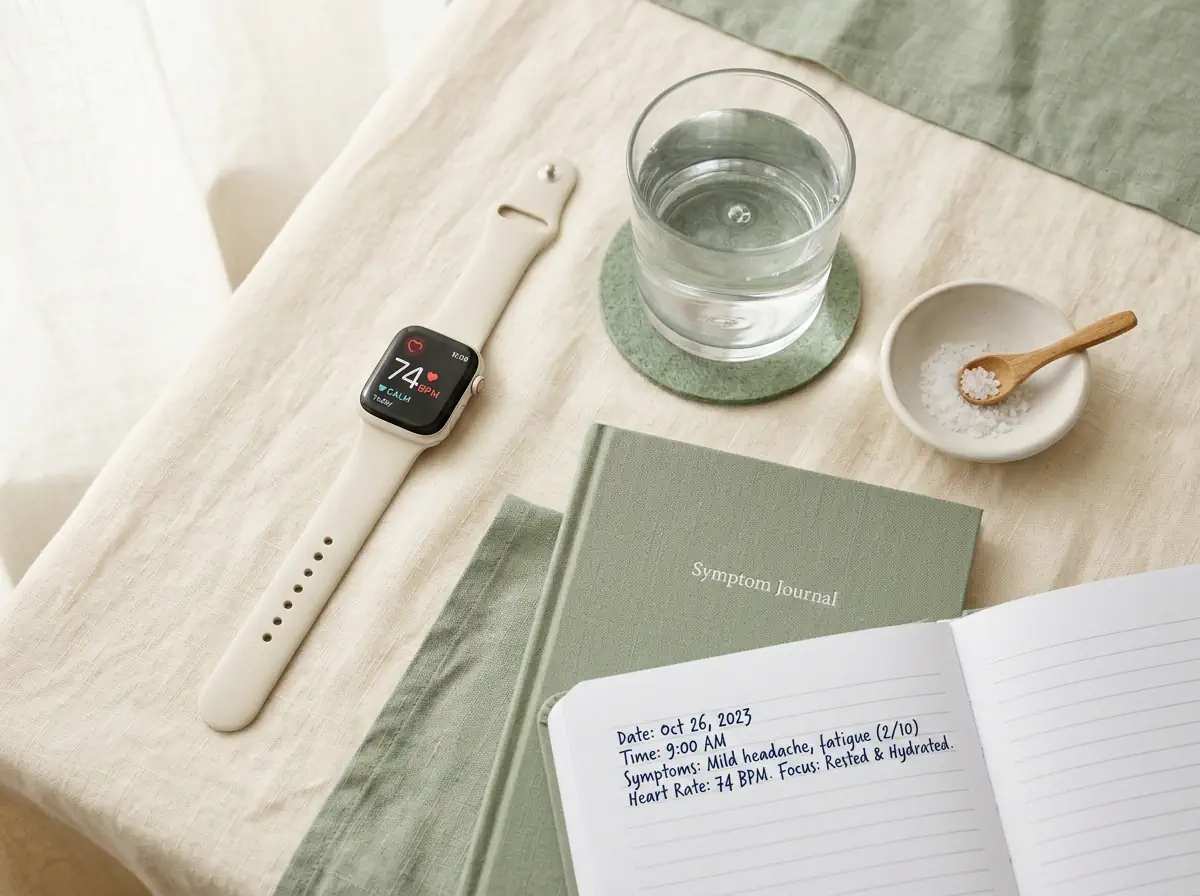
This is the big one for POTS. Since POTS is defined by an excessive rise in heart rate on standing, tracking your heart rate in different positions tells the most important part of your story. A simple, powerful approach: note your heart rate while lying down, then again after standing for a few minutes. The difference between those two numbers is often more revealing than either alone. You can use a smartwatch, a fitness tracker, or simply count your pulse for a minute.
Two details make your readings far more useful, and they come straight from how clinicians do it. Lie still for at least five minutes before the first reading, since a number taken thirty seconds after sitting down is not a resting rate. And take the standing reading more than once, a minute or so apart, rather than catching the highest number the moment you get up. Clinically, only a sustained rise counts, and a brief spike on first standing is common in people who don't have POTS at all.
🧂 2. Fluid and salt intake
Because low blood volume sits at the heart of POTS, fluid and salt are central to management, and tracking them helps you connect what you drank and ate to how you felt. Logging your daily water and salt intake alongside your symptoms can help you and your doctor find your personal threshold. Important caveat: increased salt isn't right for everyone, especially with high blood pressure, kidney or heart conditions, so your specific targets are something to set with your doctor, not guess.
📋 3. Your key symptoms, with severity
You don't need to track every possible symptom. Pick the handful that affect you most, and rate them simply, for example from 1 to 10. Common ones worth watching include dizziness or lightheadedness, brain fog, fatigue, heart palpitations, and near-fainting (presyncope) episodes. Adding a quick severity score turns vague impressions into trends you can actually see over weeks.
🔍 4. Possible triggers and context
A few words of context next to a bad day is where the real insight hides. Note things like heat, a hot shower, standing for a long time, poor sleep, stress, your menstrual cycle, or a skipped meal. Over time, this is what lets you spot correlations, such as crashing on hot days or mornings after bad sleep being worse, and start planning around them.
💊 5. Medications and the basics
If you take medication or supplements, logging them, and when, helps you and your doctor see what's helping, what isn't, and any side effects. Note the date you start anything new, because that single detail is what makes a change evaluable later. Rounding it out with a couple of basics, sleep quality and overall energy for the day, gives a fuller picture without much effort.
🔗 Want more like this? Browse all our POTS guides →
🔥 How to track without burning out
The best tracking method is the one you'll actually keep up with. A few gentle principles:
📄 Keep it to one page or one screen. If it takes more than a minute or two, it's too much. Simplicity is what makes it sustainable.
⏱️ Track at consistent moments. Many people find a morning check-in (heart rate, sleep, energy) plus a quick evening note (symptoms, fluids, triggers) is enough.
🌤️ On flare days, lower the bar. Even just a severity score and one word about why is valuable. Something beats nothing.
📱 Choose paper or digital based on what fits you. Apps offer reminders and charts; a printable page offers calm simplicity with no screens or notifications. Neither is "better", only what you'll stick with.
🗣️ Turning your notes into something your doctor can use
Tracking pays off most at appointments. Rather than handing over weeks of raw data, take five minutes beforehand to review your log and pull out two or three key points or trends: your typical standing heart rate jump, your worst triggers, or a symptom that's clearly worsening. Highlighting trends, meaning what's better, worse, or new, makes your record easy for a busy clinician to absorb, and makes you much more likely to be heard.
🌿 Two weeks is enough to stop guessing
You will not remember, in October, whether the Tuesday was worse than the Thursday or what you'd done the day before either of them. Written down, the pattern surfaces on its own, and you walk in with a trend instead of an impression, which is the difference between being managed and being believed.
Free, always. Unsubscribe in one click 🌿
❓ Frequently asked questions
Do I really need to track every day?
No. Daily logging is ideal because it captures the most detail, but even short notes a few times a week can highlight meaningful patterns over time. Consistency matters more than perfection, so track in a way that helps you, without adding stress.
What's the single most useful thing to track for POTS?
Your heart rate in different positions, particularly the difference between lying down and standing. Since POTS centres on an excessive heart rate increase on standing, this is usually the most revealing single metric, and the one your doctor will be most interested in.
How should I actually take a lying and standing heart rate at home?
Lie still for at least five minutes, then record your heart rate. Stand up and record it again after a minute, and once more a minute or two later. Clinically what counts is a sustained increase, seen on more than one reading, rather than the peak number in the first few seconds. Recording it the same way each morning matters more than the exact method.
How do I track salt and fluids without obsessing?
Keep it approximate, since you don't need to weigh everything. A rough daily note of how much you drank and whether you added salt is enough to spot patterns. And remember that salt targets are individual and should be set with your doctor, especially if you have blood pressure, kidney or heart concerns.
How long before a pattern actually shows up?
Usually about two weeks for day-to-day triggers like heat, sleep and fluids, and two to three cycles if you suspect a monthly pattern. Before that, a run of bad days is hard to distinguish from a bad week, which is exactly why starting before you need the answer is worth it.
Is paper or an app better for tracking POTS?
Whichever you'll actually use. Apps offer reminders, automatic heart rate syncing and charts; a simple printable page offers calm, screen-free simplicity. Many people find a one-page printable less overwhelming to start with. The best method is the sustainable one.
📚 Sources & further reading
The medical information in this article is drawn from the following reputable, publicly available sources. We encourage you to read them, and to always confirm anything relevant to your own health with a qualified professional.
Raj SR, Guzman JC, Harvey P, et al., Canadian Journal of Cardiology 2020: Canadian Cardiovascular Society Position Statement on Postural Orthostatic Tachycardia Syndrome (POTS) (how orthostatic vital signs are measured, section 6.2 and recommendation 4)
Cleveland Clinic: Postural Orthostatic Tachycardia Syndrome (POTS) (definition, low blood volume, symptoms)
PoTS UK: Diet and Fluids (fluid and salt guidance, individualised targets)
British Dietetic Association: How a dietitian can support people with PoTS
Continue reading
⚕️ Medical disclaimer: This article is for general information and personal organisation only. It is not medical advice, diagnosis or treatment. POTS is highly individual, so always consult a qualified healthcare professional about your symptoms, and before changing your fluid, salt, medication or lifestyle routine.