
Medical Binder for Chronic Illness: How to Build One That Works
🗂️ Your neurologist wants the tilt-table results. Your rheumatologist wants the genetics letter. The new GP wants a list of everything you've tried. And all of it is scattered across three patient portals, a folder of emails, and a plastic bag of paperwork on top of the fridge.
📁 A medical binder is the low-tech fix for a problem that digital records were supposed to solve and mostly didn't. Not another thing to maintain, just one place where the answer already exists when someone asks.
💚 And you shouldn't have to reconstruct your own history from memory, in a room where you already feel unwell. That's the whole point of writing it down once.
🗂️ START WITH THE FOUR PAGES
A partial binder that exists beats a complete one you never began. Our free Medical Binder Starter Kit gives you the one-page health summary, the binder index and the two logs, undated, in both A4 and US Letter.
⚡ Instant download · 🖨️ Print only the page you need · No spam, ever 🌿
📁 Why paper, when everything is supposedly online
Patient portals are genuinely useful, and they are also fragmented. Each hospital system runs its own, they rarely talk to each other, and the moment you see a specialist outside your usual network, that record lives somewhere your other doctors can't reach. Mayo Clinic makes this point directly: if you see two or more clinicians who don't share an electronic record system, keeping your own personal health record is what puts everything in one place.
There's evidence behind it, too. Research on personal health records has found that people who keep one know more about their own health, make better medical decisions, follow treatment plans more closely, and use preventive services more. In one study of older cardiac patients, those keeping a personal record had better health outcomes, plausibly because they and their carers could actually see the whole picture.
And there's the situation nobody plans for: the appointment where you're too unwell to explain yourself. A binder works when your memory doesn't.
🔗 Want more like this? Browse all our chronic illness life guides →
🗂️ What actually goes in it
Kaiser Permanente's guidance is refreshingly plain: a three-ring binder with dividers, and pockets for loose test results. That's the whole technology. What matters is the sections.
The one-page summary. Diagnoses, dates, current medications, allergies, key specialists. This is the page that does most of the work, and there's more on it below.
Test results and imaging reports. Bloodwork, tilt-table, echocardiogram, tryptase panels, scans. Filed by date, newest at the front.
Clinic letters and discharge summaries. The documents that prove a diagnosis was actually made rather than mentioned.
Medications, past and present. Including what you stopped and why, because clinicians ask this constantly and nobody remembers accurately. Our free printable medication tracker is built to be this section on its own, with a start date beside every entry.
Insurance, claims and bills. Approvals, denials, appeal letters. Our guide to medical bills and paperwork covers what to do with them.
Questions for next time. A running page, added to between appointments, so you stop leaving with the important one unasked.
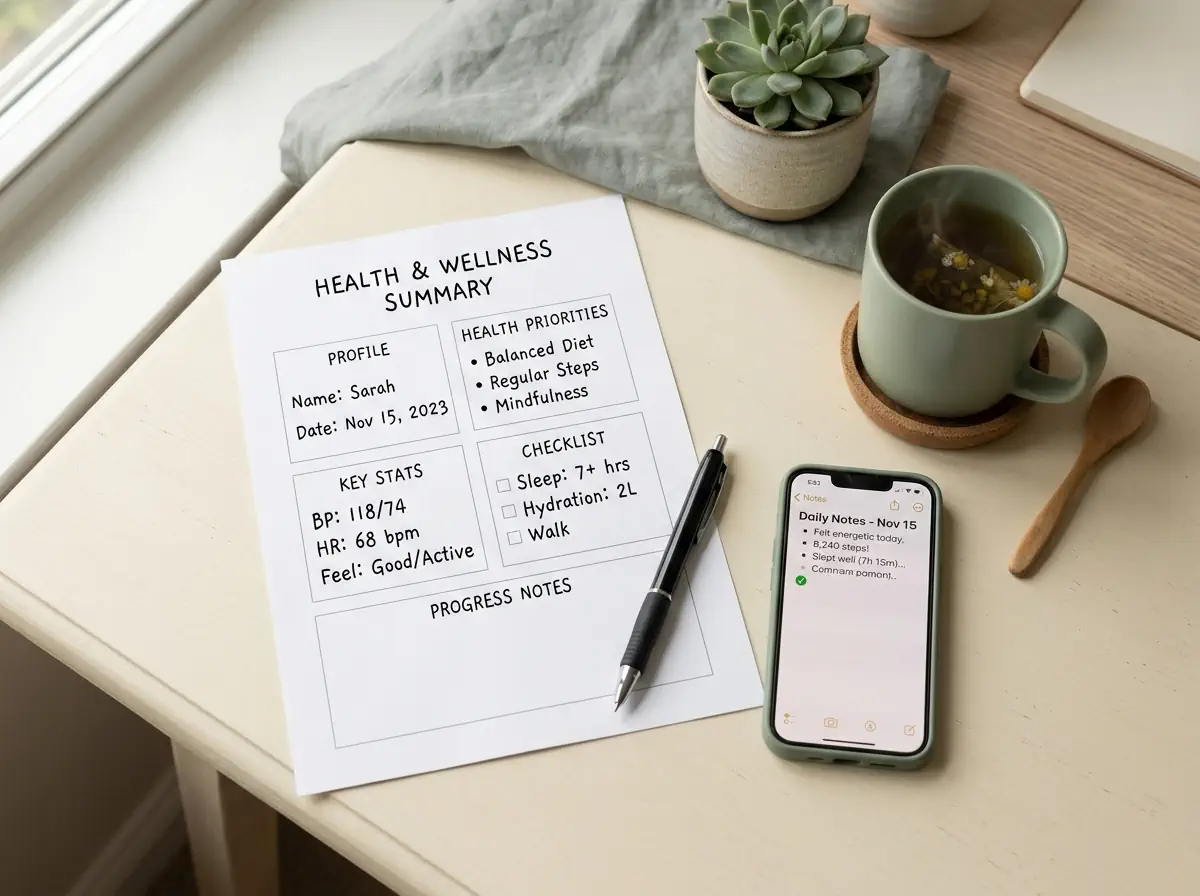
📄 The one page that matters most
If you only ever make one part of this, make the summary page. One side of paper: name and date of birth, diagnoses with the year each was confirmed, current medications and doses, allergies and adverse reactions, your specialists and their contact details, and one line on what a bad day looks like for you.
Print several copies. One lives at the front of the binder, one in your bag, one photographed on your phone. In an emergency department where nobody has met you before, this page is the difference between being assessed and being interviewed while you feel awful. It's also the single most useful thing to have in your hospital go-bag.
Mayo also suggests carrying a card in your wallet or wearing a medical alert bracelet for the same reason: the information needs to be findable when you can't hand it over yourself.
📬 How to get hold of your records
You are entitled to copies of your own records, and the request is more routine than it feels. Ask the medical records department of each clinic, in writing where possible. Two things make it easier: request a narrower set rather than everything ever written about you, since smaller batches are cheaper and far easier to organise, and ask upfront how long it will take, because the answer is usually weeks rather than days.
Start with whichever specialist matters most right now. A partial binder that exists beats a complete one you never began.
🔄 Keeping it current without it becoming a project
The binder fails the same way trackers fail: by becoming another task you're behind on. The fix is to add to it only when something happens, meaning an appointment, a new prescription or a test result, rather than setting aside time to maintain it.
Two habits carry most of it. File the letter the day it arrives, before it joins the pile. And update the summary page whenever a medication or diagnosis changes, which is a two-minute job if you do it then and an hour if you do it in six months.
💻 Paper, digital, or both
Plenty of people run both: a physical binder for appointments and emergencies, and photos of every page in a folder on their phone as backup. The phone version is what saves you when the binder is at home and you're not.
If handwriting is difficult, and with hypermobility it often is, a printed template you tick and fill takes far less hand strength than writing free-form, and a tablet with a PDF app removes the problem entirely. All of ours are laid out that way; they live on our free printables page.
You are not being excessive. Nobody with one condition and one doctor needs a binder. When you have four specialists who've never spoken to each other, being the person who holds the whole picture isn't over-organisation. It's the job nobody else is doing, and it fell to you by default.
❓ Frequently asked questions
What should a medical binder include?
At minimum: a one-page summary of diagnoses, medications and allergies; test results and imaging reports; clinic letters and discharge summaries; a medication history including what you stopped and why; insurance and billing paperwork; and a running list of questions for your next appointment.
Is a medical binder better than a patient portal?
They do different jobs. Portals are excellent within one health system but rarely connect across them, so a specialist outside your network can't see what another one wrote. A binder is the layer that sits above all of them, which is exactly why Mayo Clinic recommends keeping your own record if you see clinicians who don't share a system.
How do I get copies of my medical records?
Ask the medical records department of each clinic or hospital, in writing where possible. Requesting a narrower set rather than your entire history is usually cheaper and much easier to organise, and it's worth asking upfront how long copies will take, since it is often weeks.
What's the difference between a medical binder and a symptom tracker?
A tracker records what's happening now: daily symptoms, heart rate, energy, triggers. A binder stores what has already happened, meaning diagnoses, results, letters and medication history. Trackers show patterns; binders prove history. Most people end up wanting both, with the tracker pages filed at the front of the binder, and our free daily wellness tracker is built for exactly that.
How do I keep track of my medications for the binder?
Write the name exactly as printed on the box, the strength, when you take it, who prescribed it and, the part almost everyone skips, the date you started. That date is what turns a list into a timeline, and it's the detail clinicians ask about most. Our free medication tracker lays out those columns for you, along with a page for recording anything you noticed after a change.
Do I need a binder if I'm not diagnosed yet?
Arguably more so. An undiagnosed history is scattered across the most clinics and remembered by the fewest people. Starting a binder while you're still seeking answers means each new specialist gets the full picture rather than the version you can recall that morning.
🗂️ STILL WANT THE STARTER KIT?
Four pages, undated, in both A4 and US Letter: the one-page summary, the binder index, the test log and the appointment log.
📚 Sources & further reading
The information in this article is drawn from the following sources. We encourage you to explore them.
Mayo Clinic: Personal health records and patient portals
Johns Hopkins Medicine: Medical Records: Getting Organized
Kaiser Permanente: Organizing Your Medical Records
Centers for Medicare & Medicaid Services: Personal Health Records
StatPearls (NIH): Personal Health Record
Continue reading
⚕️ This article is general information for the chronic illness community and is not medical advice. A medical binder is a personal organisation tool and does not replace your clinical records or your care team.