Double Jointed Hands and Fingers: Why They Start to Hurt
Being double jointed in your hands is the thing people show off at school. Bending a thumb back to the wrist, folding fingers into shapes nobody else can make, the party trick that always gets a reaction.
Then somewhere in your twenties the party trick stops being funny. Writing hurts after ten minutes. You drop things. Your thumb aches from holding a phone.
Hypermobile hands are the most used joints in the most flexible part of the body, which is why they are so often where the problem shows up first, and so often the last thing anyone examines.
✋ What double jointed actually means
Nobody has two joints. The term describes a joint that moves beyond the range considered typical, because the ligaments holding it allow more movement than usual.
Your hand has 27 bones and around 30 joints. In the fingers alone there are three joints each, all small, all stabilised mostly by ligament rather than by muscle bulk. If your connective tissue is more lax, that laxity has a great many places to express itself.
Two of the nine points on the Beighton score, the standard screening measure for generalised hypermobility, are in the hands: bending the little finger back beyond 90 degrees, and bringing the thumb down to touch the forearm. If you can do either, that is not a curiosity. It is a scored clinical finding.
📋 "I'm just double jointed" is what stops people getting assessed
Hands are usually where it starts and the last place anyone looks, because it never makes the list you bring. Our free hEDS Appointment Kit is that list: the whole picture on one page you can tick and hand over, plus a page for the three things that matter most and what each one stops you doing.
💯 100% free · 📄 3 printable pages, A4 and US Letter · 🚫 No spam, unsubscribe in one click
✍️ Why writing and typing hurt first
Holding a pen requires a stable grip between thumb and fingers. If the joints in that grip are not held firmly by ligament, your muscles have to do the holding instead.
Muscles are not built for sustained static holding. They fatigue, then they ache, then they cramp. This is why hand pain in hypermobility is usually described as arriving after a period of use rather than at the first moment, and why it improves with rest and returns with the next task.
The most common visible sign is the swan neck position, where the middle joint of a finger bends backwards while the tip curls forward. Many hypermobile people write with fingers in exactly that shape without ever having noticed.
🔗 Want more like this? Browse all our hypermobility guides →
🤲 Why you grip too hard, and why that is a trap
Grip force is calibrated by feedback from the joint. Where connective tissue is lax, that feedback arrives slightly late and slightly imprecise, so the brain compensates by squeezing harder than the task needs.
You end up holding a coffee cup with enough force for a hammer. It works, and it costs you: more fatigue, more load through joints that were already unstable, and more pain by evening. Our guide to proprioception in hypermobility explains the mechanism behind it.
The counter-intuitive fix is to grip less, deliberately, on a chosen task. It feels unsafe at first and it is the single most useful habit change for hypermobile hands.
🛠️ What actually helps
Wider grips on everything. A fat-barrelled pen, a foam tube over a toothbrush, a thicker knife handle. A wider object needs less force to hold, which is the whole point. This is the cheapest intervention available and often the most effective.
Ring splints for individual fingers. Small silver or plastic rings that block a single joint from hyperextending while leaving the rest of the hand free. They are prescribed by hand therapists and they are notably discreet, which matters to people who will not wear an obvious splint.
Voice dictation for long writing. Not a defeat. It removes the single most repetitive load your hands take.
Two hands where you have been using one. Kettles, saucepans, doors. Splitting the load halves the demand on each joint.
Intrinsic hand strengthening, prescribed by a hand therapist rather than found online. Generic hand exercises frequently emphasise stretching, which is the opposite of what a hypermobile hand needs.
Compression gloves help some people, mostly through sensory feedback rather than mechanical support, in the same way compression sleeves work elsewhere. Worth trying, not worth counting on.
⚠️ Stop doing the party trick
This deserves saying plainly, because everyone with hypermobile hands has been asked to perform.
Every time you push a joint to its extreme, you stretch the ligament a little further. Ligament does not spring back the way muscle does. The bend that impressed people at fifteen contributes to the joint that aches at thirty.
You do not have to explain this to anyone. "I don't do that any more" is a complete sentence.
🩺 When it is worth raising with a doctor
Hypermobile hands alone are common and often harmless. What makes them worth investigating is the company they keep.
If hand pain sits alongside fatigue, dizziness on standing, gut symptoms, skin that bruises easily or joints elsewhere that slip, that is a pattern rather than a collection of unrelated complaints. Our guide to where the line sits between hypermobility and hEDS covers how that distinction is made.
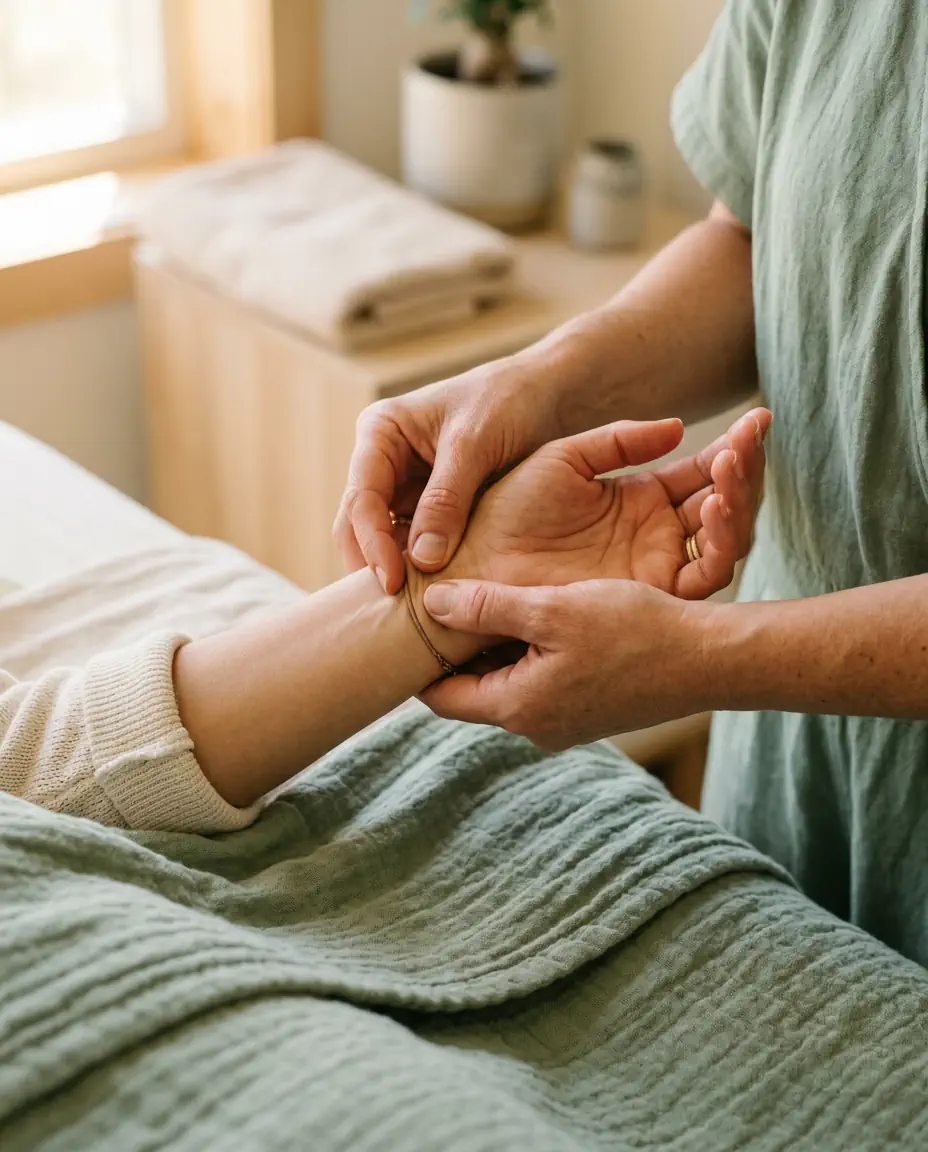
The referral to ask for is a hand therapist, an occupational therapist or physiotherapist who specialises in hands. They assess grip, prescribe splints and build a programme. It is a far more specific ask than "my hands hurt", and it tends to get a far more specific answer.
💚 It was never just a party trick
A lot of people spend years being told their bendy fingers are a fun quirk, then feel foolish raising them as a medical issue. The Beighton score literally counts them. You are not making something out of nothing.
📋 Ask for a hand therapist, not just an appointment
The specific referral works far better when the pattern is already written down in front of them. The free hEDS Appointment Kit has a page for exactly that: when it is worse and easier, what has already been tried and whether it helped, and the three symptoms to lead with.
Free, always. Unsubscribe in one click.
❓ Frequently asked questions
Is being double jointed in your fingers bad?
Why do my hands hurt after writing for a short time?
What are ring splints and do they work?
Does being double jointed mean I have Ehlers Danlos syndrome?
Should I stop bending my fingers back?
📚 Sources and further reading
The information in this article is drawn from the following sources. We encourage you to explore them, and to have hand symptoms assessed by a hand therapist or clinician familiar with hypermobility.
The Ehlers-Danlos Society: Assessing Joint Hypermobility
The Ehlers-Danlos Society: Braces, Splints & Mobility Aids
Hypermobility Syndromes Association: Living with hypermobility
Continue reading
⚕️ This article is general information for the chronic illness community and is not medical advice. Splints, exercise programmes and grip aids should be assessed and prescribed by a hand therapist or clinician familiar with hypermobility.