FREE PRINTABLE FOR POTS AND DYSAUTONOMIA
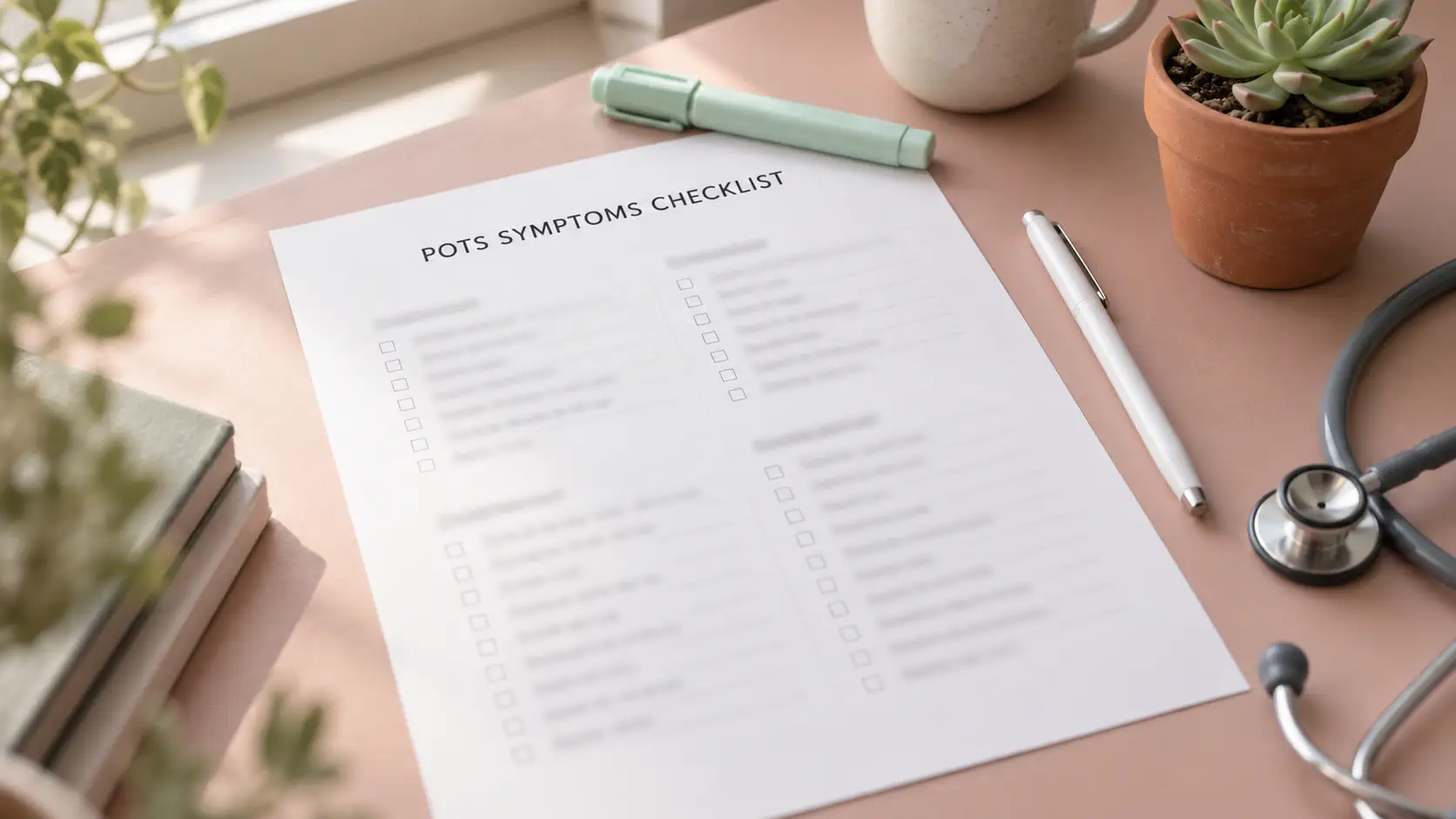
Ten minutes is not enough time to remember eleven months.
Tick it at home, hand it over in the room. Three printable pages, free.
⚡ Instant download · 🖨️ A4 and US Letter in one PDF · Undated · No spam, ever 🌿
The problem is not that you forget. It is that you are asked to summarise years, standing up, in a corridor of a day.
You rehearse it on the way in. Then the door opens, someone asks how you have been, and out comes the one symptom that happened this morning. The other twenty stay in your head, and the appointment ends with a plan built on a fraction of the picture.
A page you filled in calmly at home does not have that problem. It says the same thing whether it is a good day or a bad one, and it takes about thirty seconds to read.
What the three pages do
✅ Page 1 : the whole picture
Tick-box symptoms grouped by area of the body. One isolated symptom gets explained away. A cluster crossing several systems does not.
📈 Page 2 : the pattern
When things are worse and when they are better, with space to write your standing heart rate. This is the page that turns a description into an observation.
🩺 Page 3 : the three
The three that matter most, and what each one stops you doing. Because you will not get through all of them, and you get to choose which ones survive.
Why the third page is the one people come back to
Most appointments end early. Not out of unkindness, but because time runs out, and whatever you happened to mention first is what gets acted on.
Deciding your three in advance means the important ones are said out loud instead of being the ones you remember in the car park. The column next to them matters just as much: not the symptom, but what it stops you doing. Dizzy is easy to file away. Cannot stand long enough to make dinner is not.
💚 You do not need a diagnosis to use it
Plenty of people print this precisely because they are trying to get one. Walking in with a written pattern is one of the most useful things you can do when the answer has been taking years, and it works exactly the same before a diagnosis as after one.
Print it, fill it in on a tablet, or keep it in a folder
One PDF containing both A4 and US Letter, so you print whichever your printer takes. It is undated, so nothing expires and nothing is wasted. You can also annotate it on a phone or tablet in any PDF app.
Questions, answered
Is it really free?
Yes, completely. Enter your email and the PDF arrives in your inbox straight away. No card, no trial, no catch.
Is this a diagnostic test?
No, and it is important to be clear about that. Ticking a lot of boxes does not diagnose anything, and several other conditions produce a similar picture. This is a record you fill in and hand over, so the person assessing you has the whole picture instead of the fraction that fits in ten minutes.
Do I need a diagnosis to use it?
No. It is arguably more useful before one. A written pattern is often what moves a stalled process forward, because it turns a description given from memory into something a clinician can read in thirty seconds.
What if I do not know my standing heart rate?
Leave it blank and fill it in later, or bring what you have. The page works without it. If you do want to record it, our guide on what to actually track explains the few things that carry most of the signal, and how the measurement is usually taken.
What format is it?
One PDF containing both A4 and US Letter versions, A4 first. Print as many copies as you like for personal use, or fill it in digitally on a tablet or phone with any PDF annotation app.
Will I get emails afterwards?
You will receive the checklist immediately, then a short series about using it. You can unsubscribe in one click at any time.
Is this medical advice?
No. It is a personal organisation tool for recording your own symptoms, nothing more. It does not diagnose, advise or replace an assessment by a qualified clinician.