
Occupational Health Referrals: What Actually Happens
The email lands on a Tuesday afternoon: we'd like to refer you to occupational health. And your stomach drops, because it reads like the beginning of the end. That reaction is so common that Acas has written about it: people frequently take an occupational health referral as a step on the road to dismissal, rather than what it is designed to be.
It is meant to be the opposite. An occupational health referral exists so that decisions about your job get made with medical input instead of guesswork. If you have POTS, hEDS, MCAS or any other condition your manager doesn't understand, that shift is usually in your favour, because right now they are deciding based on what they can see, which is someone who keeps disappearing.
🌿 "I get dizzy" is a symptom. A task and a time is a limitation.
The whole assessment turns on that difference, and it is close to impossible to improvise in the room. Walk in able to say which task, at which hour, and how often, and the clinician has something they can write an adjustment from.
⚡ Instant download · 🖨️ A4 and US Letter · Undated · No spam, ever 🌿
🩺 What occupational health is actually for
Occupational health is a medical service, but it is not your medical care. The clinician isn't there to diagnose you, treat you, or second-guess your consultant. They are there to answer a narrow set of questions your employer has asked, in work terms: what you can do, what you can't do reliably, what would change that, and roughly for how long.
That narrowness is worth understanding, because it explains a lot about how the appointment feels. Nobody is going to explore your full history. They want to know whether standing for forty minutes is the problem, or whether it's the 8am start, or the strip lighting, or all three.
In the UK, an occupational health professional can also give an opinion on whether you meet the Equality Act 2010 definition of disability, meaning a physical or mental impairment with a substantial and long-term negative effect on your ability to do normal daily activities. That opinion isn't a court ruling, but it changes the conversation, because the duty to make reasonable adjustments follows from it.
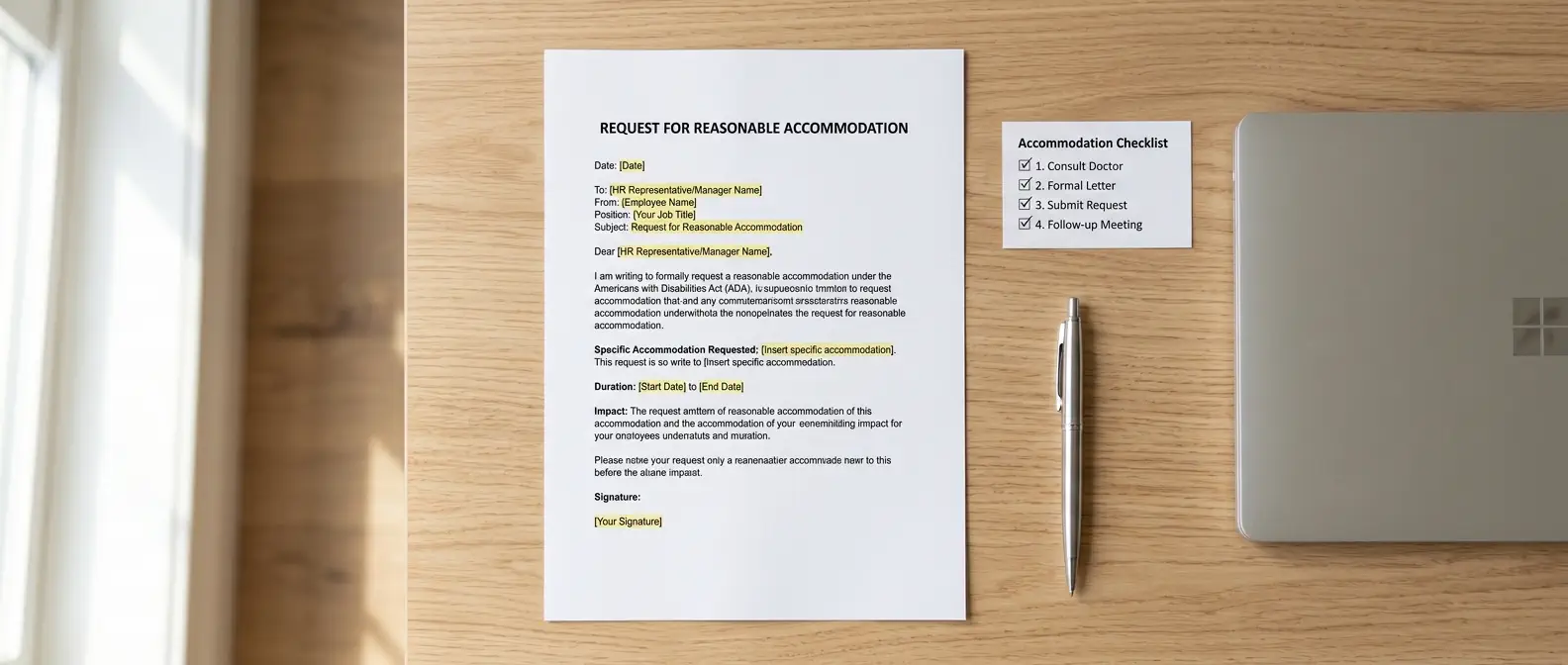
✅ The consent rights that stay yours
This is the part almost nobody is told, and it changes how the whole process feels.
Your employer should speak to you about the referral and obtain your consent before making it.
You have the right to see the report before it is released to your employer, and you can refuse consent for it to be released at all.
If a doctor carries out the assessment, your employer must inform you in writing of your rights under the Access to Medical Reports Act 1988.
If the occupational health adviser wants information from your own GP or specialist, you have to sign a separate consent form, and you have the right to see that report before it goes to them.
Your employer should tell you how they are storing and using the report, and how to withdraw your consent later if you change your mind.
Refusing consent isn't free, though, and it would be dishonest to pretend otherwise. If you block the report, your employer is left making decisions on what they already know, which is usually less than you'd like. Acas is direct about this trade-off. The right exists to protect you from a report that misrepresents you, not as a routine move.
🔗 Want more like this? Browse all our living with chronic illness guides →
📋 How to prepare in twenty minutes
The single most useful thing you can do is arrive with your limitations already described in work language rather than symptom language. "I get dizzy" is a symptom. "I can't stand at the counter for more than about fifteen minutes before I need to sit, and it's worse before lunch" is a work limitation, and it converts directly into an adjustment.
Write one page before you go. Three headings is enough: what my job asks of me, where it goes wrong, and what has helped when I've tried it. Bring dates. If you've been tracking symptoms, bring the pattern rather than the notebook, because a month of morning heart-rate readings is far more persuasive than a good description.
Ask, in advance, for a copy of the referral form or at least the list of questions your employer has asked. You are entitled to know what is being asked about you, and it lets you prepare answers instead of being ambushed by them.
📄 What the report says, and what to do with it
The report goes back to your employer answering their questions: whether you're fit for work with or without adjustments, what adjustments are suggested, likely prognosis, and when to review. Good practice is that nothing in it surprises you, and the clinician should have discussed the gist before sending it.
Read it properly when it arrives. Two things go wrong often enough to watch for: an adjustment you never discussed appearing as a recommendation, and a symptom being described as "reported" in a way that quietly signals doubt. Both are fixable if you raise them before release, and much harder afterwards.
The report is advice, not an instruction. Your employer decides what to implement. If they ignore recommendations entirely, that refusal is now documented, which is exactly why the paper trail matters.
🌿 The word to watch for in the report is "reported"
A symptom written as reported quietly signals doubt, and that line is far easier to challenge before release than after. Dates and readings are what move a sentence from something you said to something the clinician could see for themselves.
Free, always. Unsubscribe in one click 🌿
Common questions
Can I refuse to attend occupational health?
You can decline, but it rarely helps you. Your employer is then making decisions without medical advice, and tribunals have taken a dim view of employees who refused occupational health input and later claimed adjustments weren't made. If you're worried about the process, ask to see the referral questions first rather than refusing outright.
Will occupational health tell my employer my diagnosis?
Their job is to advise on function and adjustments, not to hand over a diagnosis deep-dive, and you see the report before it's released. If you'd rather your specific diagnosis wasn't named, say so at the appointment. Adjustments are built on limitations, not labels.
Is an occupational health referral the same as being put on a capability process?
No. They're separate things, though they sometimes appear in the same period. Acas actually recommends using occupational health earlier, as part of ordinary management to arrange adjustments, rather than only when absence has become a problem.
How far back should my notes go before the assessment?
Two to four weeks of dated entries is usually enough to show a pattern rather than a bad week, and it fits inside the wait between the referral and the appointment. What matters more than length is that entries are written on the day itself, because memory reshapes a month into whatever state you are in when you describe it.
Do I get paid for the time?
That should be set out in your organisation's policy rather than decided ad hoc, so it's worth checking before you go.
Sources
UK Government: Access to Medical Reports Act 1988
Continue reading
The two pieces that pair with this one: one for the formal letter that opens the process, one for the informal email that often comes first.
⚕️ This article is general information, not legal or medical advice. Employment rules differ by country and by employer. If your job feels at risk, speak to an employment adviser, a union representative or a solicitor.