FREE PRINTABLE FOR hEDS AND HYPERMOBILITY
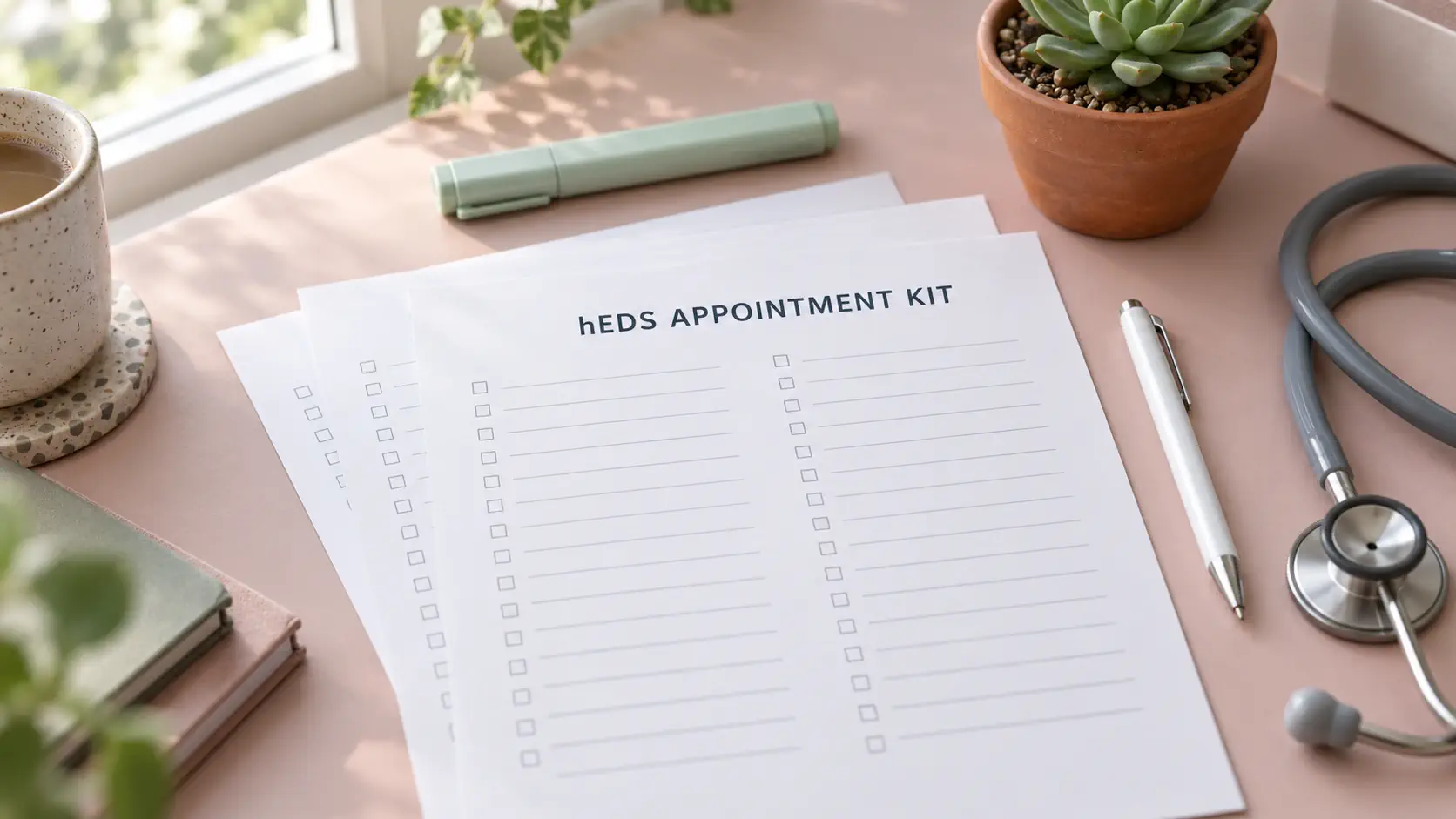
Walk in with the pattern already written down.
What to bring, what it looks like over time, and the three to say first. Three printable pages, free.
⚡ Instant download · 🖨️ A4 and US Letter in one PDF · Undated · No spam, ever 🌿
Hypermobility appointments go wrong in a specific way
You have a joint that slips, a wrist that hurts after writing, fatigue nobody can explain, a gut that has been called irritable for years. Mentioned separately, each one is small. Mentioned together, they are the reason you are there.
What decides how the appointment goes is whether the connection between them is visible before you start talking. That is what these three pages are for.
What the three pages do
🎒 Page 1 : what to bring
What is worth having with you, so you are not reconstructing your own history across two decades from memory.
📈 Page 2 : the pattern
Which joints, how often, after what, and what has already been tried and whether it helped. The page most people skip, and the one that carries the appointment.
🩺 Page 3 : the three
The three symptoms to say first, and what each one stops you doing. Decided calmly, before the door opens.
Why the column about what has already been tried matters
A great deal of time is lost recommending things you tried three years ago. Physiotherapy that made it worse, a brace that never fitted, an exercise programme abandoned after two weeks because of what it cost you.
Written down, that history stops the same suggestions coming round again and turns a failed attempt into information rather than a mark against you. A programme that set you back is not evidence you did not try. It is evidence about which approach suits your joints.
💚 It is not a self-assessment, and that is deliberate
There is nothing here that asks you to test your own joints or score yourself. Pushing a joint to its limit to see what it does is exactly what a hypermobile body does not need, and scoring belongs in the room with someone watching. This is a record, not an examination.
Questions, answered
Is it really free?
Yes, completely. Enter your email and the PDF arrives in your inbox straight away. No card, no trial, no catch.
Is this a hypermobility test?
No, and deliberately so. It contains no self-scoring and asks you to bend nothing. The Beighton score is applied in a consultation by someone assessing you, and pushing joints at home to score yourself is not a good idea. This kit is a record you fill in and hand over.
Do I need a diagnosis to use it?
No. It is arguably most useful before one, when the whole problem is that a dozen separate complaints have never been looked at together. Our guide to where the line sits between hypermobility and hEDS covers how that distinction is actually made.
Which appointment is it for?
Any of them. It works for a first GP conversation, a rheumatology referral, or a first session with a physiotherapist, since all three start with the same question about what has been happening and for how long.
What format is it?
One PDF containing both A4 and US Letter versions. Print as many copies as you like for personal use, or fill it in digitally on a tablet or phone with any PDF annotation app.
Will I get emails afterwards?
You will receive the kit immediately, then a short series about using it. You can unsubscribe in one click at any time.